
Emphasising that everything is created from Sun, Prime Minister Narendra Modi on Tuesday called for 'One Sun, One World, One Grid' to improve the viability of solar power and announced that India's space agency ISRO will soon provide the world a calculator that can measure solar energy potential of any region across the globe. Addressing world leaders at the event 'Accelerating Clean Technology Innovation and Deployment' on the sidelines of the climate summit in Glasgow, Modi said that fossil fuel powered many nations to become wealthy during the industrial revolution, but it made the earth and environment poor.

Currently, the NAPCC has eight active missions across sectors like water, energy, and agriculture, aimed at addressing climate change.

'If you align your ambition with India's rise, the peak of your careers will unfold alongside the peak of India's power.'

VF 7 and VF 6, as the models are called, will go on sale in August after the inauguration of VinFast's plant in Thoothukudi in Tamil Nadu, and deliveries will follow later.

Max Verstappen, who could seal his fourth successive championship on Saturday, will line up fifth on the starting grid

Electronic line calling systems were also affected by the power cut, the ATP said, while spectators shared pictures of dark hallways at the Manzanares Park Tennis Center.

Siam argues that a 2040 ban could destabilise ongoing and future investments and threaten millions of jobs in the automotive value chain.

The International Monetary Fund (IMF) has slapped 11 new conditions on Pakistan for the release of the next tranche of its bailout programme and warned that tensions with India could heighten risks to the scheme's fiscal, external, and reform goals, according to a media report on Sunday.

From the 30-share pack, Bajaj Finserv, Mahindra & Mahindra, Eternal, Power Grid, ITC, Tata Motors, Asian Paints and Hindustan Unilever were among the gainers. Among the laggards, Kotak Mahindra Bank tanked 4.57 per cent
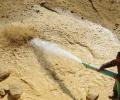
'The government is actively engaging with EU to ensure that concerns of Indian companies and hard-to-abate sectors are adequately addressed under CBAM'
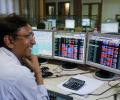
From the 30-share Sensex pack, Bharti Airtel, Mahindra & Mahindra, UltraTech Cement, Adani Ports, Reliance Industries, Larsen & Toubro, JSW Steel, Hindustan Unilever, Titan and Tata Motors were the biggest gainers. Power Grid, Nestle, State Bank of India and Infosys were the laggards.

Focuses on meeting non-traction demand through renewables.

All Sensex firms, except Power Grid, ended in the positive territory. Titan, Bajaj Finance, State Bank of India, Larsen & Toubro, Axis Bank, Bajaj Finserv, Asian Paints and Zomato were the biggest gainers.
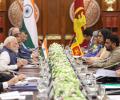
Prime Minister Narendra Modi received a tri-services ceremonial welcome in Colombo, Sri Lanka, marking the first time such an honor has been bestowed upon a foreign leader. The welcome took place at the historic Independence Square, the venue for national day celebrations. Modi's visit comes as Sri Lanka shows signs of recovery from a recent economic crisis, with India playing a significant role in providing assistance. During the visit, both leaders are expected to discuss a range of issues, including defense cooperation, energy, and digital initiatives.

Investors became richer by nearly Rs 8 lakh crore on Wednesday as benchmark BSE Sensex surged by 740 points amid value buying in utilities and power shares and a strong trend in global markets. The 30-share BSE Sensex surged by 740.30 points or 1.01 per cent to close at 73,730.23.

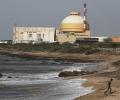
Kudankulam will house the largest nuclear power plants in India and the flagship project of Russian-Indian technological and energy cooperation.

State Bank of India, NTPC, ITC, Asian Paints, Bajaj Finance and Bajaj Finserv were also among the major laggards. In contrast, Power Grid, UltraTech Cement, HCL Technologies and Axis Bank were among the gainers.

Despite enduring a weak first quarter of the 2023-24 financial year (Q1FY24), Power Grid Corporation (PGCIL) has laid out an ambitious capex plan going forward. It is looking to invest around Rs 1.8 trillion on an existing asset base of Rs 2.7 trillion to aim at keeping over 50 per cent market share in the transmission market. This includes opportunities from the Rs 2.4 trillion green energy corridor.

A General Motors-backed Cadillac entry will become Formula One's 11th team next year after securing formal approval from the commercial rights holders and governing FIA on Friday.
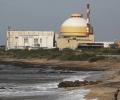
A milestone in Russian-Indian nuclear cooperation with the arrival of a reactor pressure vessel for the Kudankulam atomic power plant.

'The hacker replaced original emails and planted fraudulent emails with a request letter and invoices to be paid to fraudulent bank accounts.'
Siemens's share price has lost ground in the past few sessions following weak management commentary. The management indicated challenges to the growth outlook due to stagnant private capex and concerns over semiconductor shortages for digital industries. Government infra-spending may regain momentum from January 2025.

Six-times MotoGP champion Marc Marquez continued his perfect start with factory Ducati as he completed a weekend double at the season-opening Thailand Grand Prix on Sunday, finishing ahead of his younger brother Alex.

Trump's tariff threats spooks markets; Sensex down 106 points
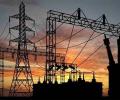
Power utilities may report moderate growth in earnings for Q3FY25. Generation is up 3 per cent year-on-year (Y-o-Y) in Q3 on lower cooling demand and high base, to 429 billion units (BU). Peak demand was steady at 224 Gw in Q3FY25, a 10 per cent decline from the record highs of 250 Gw in May 2024.
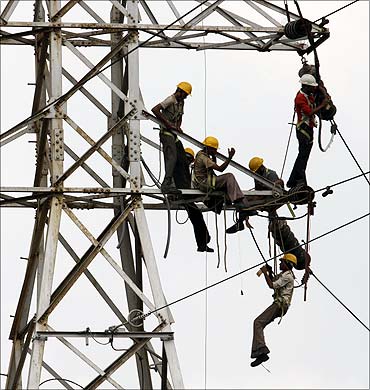
A smart grid is an electrical grid, which includes a variety of operational and energy measures, including smart meters, smart appliances, renewable energy resources and energy-efficiency resources.
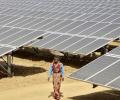
Arunabha Ghosh on why India will increasingly become an energy great power, but not an energy hegemon.
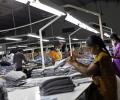
After experiencing an 11 per cent contraction in exports in 2023-24 (FY24) due to a dip in exports for 10 consecutive months from April to January, the Tiruppur textile industry is back on track in 2024-25 (FY25). The cluster, which contributes 55 per cent of the country's total knitwear exports, posted a 13 per cent increase in the first five months of this financial year (FY25), with August seeing a 22 per cent rise - the highest in over two years.

Asia's richest man Gautam Adani on Wednesday said his ports-to-power conglomerate will build three giga factories for manufacturing solar modules, wind turbines, and hydrogen electrolyzers as part of a $70 billion investment in clean energy by 2030. Adani group is stepping up investments across the green energy value chain as it aims to become the world's top renewable energy producer by 2030. "The Adani Group has already committed $70 billion (for climate change and green energy).
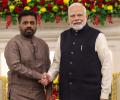
Sri Lankan President Anura Kumara Disanayaka assured Prime Minister Narendra Modi that his country's soil will not be used against India's interests, addressing concerns over China's growing influence in Colombo. The two leaders discussed a range of issues, including a defense cooperation agreement, energy ties, and debt restructuring. They also agreed to initiate a ferry service between Rameshwaram and Talaimannar, and to adopt a "humanitarian approach" to the fishermen issue.

When he is not using the solar pump on his field for irrigation, Raman Parmar uses it to evacuate power to utility grid

Falling the second consecutive session, equity benchmark Sensex dropped over 140 points on Friday, tracking weakness in banking and energy stocks amid a mixed trend overseas. Investors also remained concerned over persistent foreign fund outflows, traders said. The 30-share BSE index ended 143.20 points or 0.24 per cent lower at 58,644.82. Similarly, the NSE Nifty shed 43.90 points or 0.25 per cent to close at 17,516.30.
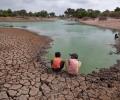
Renewable energy is mistakenly restricted to electricity.
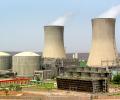
With this, the unit has exited the construction phase and began the operational phase.
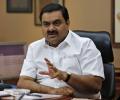
Billionaire Gautam Adani on Monday said his infrastructure conglomerate will invest between $50-70 billion in organic and inorganic growth opportunities across the entire energy value chain over the next decade. Speaking at an industry event, he said the port-to-energy group will invest over $20 billion in renewable energy generation alone. "Over the next decade, we will invest over $20 billion in renewable energy generation.
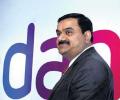
Adani Green Energy Limited is developing 30 GW renewable energy plant on barren land at Khavda in Kutch of Gujarat over area of 538 sq km after which the project would be the planet's largest power plant.
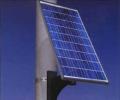
The Union new and renewable energy ministry said Uttar Pradesh was progressing "very well" in off-grid solar energy space

From the 30-share pack, Hindustan Unilever, Tata Motors, Axis Bank, Nestle India, Asian Paints, ITC, Reliance Industries, Mahindra & Mahindra, IndusInd Bank and State Bank of India were among the laggards. Larsen & Toubro, Tata Steel, JSW Steel, HDFC Bank, Adani Ports, Kotak Mahindra Bank, Bharti Airtel and PowerGrid were among the gainers.

Tata Power on Saturday said it has inked a pact with IIT Delhi to work together on clean energy and other projects that can be transformed from research and development level to pilot stage. Tata Power, one of India's largest private sector integrated utilities, and the Indian Institute of Technology (IIT) Delhi have signed a Memorandum of Understanding (MoU) to collaborate in areas like smart grid technology, clean energy solutions, a company statement said. Considering the large number of experts with their excellence in different fields in IIT Delhi and Tata Power, there is an immense potential to collaborate between academia, research and domain experts from business with a high transformational impact, it added.
